Friday, 12 October 2012

October 2012: Joan Aiken's "Midnight is a Place" and our November book

We journeyed back into some unspecified time and location this month when we opened the covers of Joan Aiken's 1974 classic, Midnight is a Place.  With grotesque characters,  a bleak and snowy countryside, a pair of ragged orphans - and a grimy mill town with an extraordinarily high workplace accident rate - it was redolent with parodic echoes of Charles Dickens and Mrs Gaskell at their most melodramatic.  It's reminiscent too of The Secret Garden and Jane Eyre.  While we winced at the author's use of "oop north" dialect to distinguish the workers from the gentry, the Boz-like illustrations by Pat Marriott added to the illusion of being somewhere in Victorian industrial England, most likely beyond the Watford Gap ... 


Born in 1924, Aiken was the daughter of Pulitzer Prize-winning American poet Conrad Aiken and the step-daughter of novelist and poet Martin Armstrong. Home-educated between the wars on a diet of much Victorian literature and early 20th century writing, her heritage is unmistakeable.  This is a quirky book, stuffed with inventive and memorable imagery, and fascinating ideas that appeal to children and adults alike.  

Those who had read Midnight is a Place when they were younger recalled most vividly the scenes in the carpet factory: particularly the enormous press thundering terrifyingly down from the roof to squash any little clot snatcher too slow to get out of the way.  As adults, we were each struck by any number of tiny and imaginative details: Handel's tuning fork, a grandmother living in a Georgian ice-house, loaves of bread baked with chestnut flour, the red coat, a mediaeval jewelled saddle fished out of the sewers, the Friendly Society that's anything but ...

Aiken's beautifully observed young hero, Lucas, sets out the central thesis in his schoolroom essay in the opening pages: "Industry is a good thing because it is better to work in a carpet factory than to be out in the rain with nothing to eat".  He then spends the rest of the book discovering the truth about this middle-class perspective on the lot of the poor.  Thrown together with the fiercely independent young French girl, Anna-Marie, and then abandoned to their own devices, the children are subjected to a series of trials and hardships so monumentally awful, in a winter so cold and dreadful, that you just long for the first sign of spring to bring some relief!  There's surprising tragedy too, including a ghastly and unexpected fight to the death with a piece of industrial equipment.

One interesting theme in Midnight is a Place is that of the role of the music teacher being used as a device to cross the divide between the gentry and the working classes.  We think this may occur in other books too - we just need to confirm this with a few examples.

Finally, the consensus was that (although the story was initially hard to get into) most of us were "gripped without loving it".  Almost too darkly melodramatic - rainswept, snowy, cold and filthy - and with any number of convenient plot twists advancing to a rapid conclusion, Midnight is a Place has just a slight tinge of a Victoria Wood Christmas Special.

Next month we're off to a boys' prep school when we're reviewing Jennings' Little Hut by Anthony Buckeridge (1951).  Supersonic!

Sunday, 16 September 2012

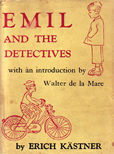
September 2012: Erich Kästner's "Emil and the Detectives" and our October book

Today was spent tracking criminals through the back streets of Berlin with Emil (Tischbein) and his two dozen or more young friends, as we reviewed Erich Kästner's 1928/9 classic children's book, Emil and the Detectives.
Born in 1899 in Dresden, by 1927 Kästner had established himself in Berlin as a prolific and respected journalist and author, and one of the most important intellectual figures in pre-WW2 Germany. A pacifist who had served as a young soldier at the end of WW1, he published poems and articles in many important periodicals and newspapers. During the book burnings in Berlin's Opernplatz on 10 May 1933 he was personally denounced (amongst others) by Goebbels in what is now known as 'die Feuerrede' (the fire speech), and his works were thrown onto the bonfires - with the exception of Emil and the Detectives, which presumably stood alone in matching up to the regime's demand for "decency and morality in family and state".

"Gegen Dekadenz und moralischen Verfall! Für Zucht und Sitte in Familie und Staat! Ich übergebe dem Feuer die Schriften von Heinrich Mann, Ernst Glaeser und Erich Kästner."  (Against decadence and moral decay! For decency and morality in family and state! I hand over to the fire the writings of Heinrich Mann, Ernst Glaeser and Erich Kästner.)
Our knowledge of the ghastly events that were just around the corner for Emil, his friends and their families adds a real poignancy to this simple yet enormously satisfying story. 1920s Berlin comes happily to life as Kästner locates the action firmly in its bohemian café society. Music plays in the streets, there's the smell of frying sausages in the air and the villain enjoys his coffee and a cigarette at a table in the famous Café Josty (the pre-war meeting place for Berlin's writers and artists which was destroyed during WW2 and has been reincarnated in the Sony Centre, one of Berlin's modern landmarks). 
The boys of 1920s Berlin had enviable freedom: unhampered by over-anxious parents with mobile phones they roamed the streets having wonderful adventures, while still managing to be incredibly polite to grown-ups and thoughtful of each other. They are largely unconcerned by social differences: Emil is a country mouse in town, but is welcomed by the streetwise young Berliners. The children - more than a hundred of them by the end of the book - inhabit their own exciting world and operate just under the adult radar; free to come and go, they have adventures that turn out well for all concerned, while a slice of apple cake and a hot chocolate is fair reward for their efforts.
Wittily illustrated by Walter Trier (an anti-fascist who was also bitterly opposed to - and by - the Nazi regime), and with Kästner's occasional humorous asides and sly insertion of himself into the story, adult readers are kept as amused as their younger audiences, and the book is refreshingly free of moralising (apart from Grandma's outdated exhortion to "always send cash through the post"). There's even the mandatory comic policeman who can't remember Emil's surname.  However, Walter de la Mare's lengthy introduction was universally condemned as a dreadful plot spoiler!
There was some discussion of the quality and nature of the English translation from the original German (we were reading Eileen Hall's 1959 version), with the view expressed by those of the group who are German speakers that the book is more genteel in tone than would have been the case. Perhaps there's an opportunity for a new translation of Emil that uses a more authentic voice and replicates the Berlin street slang of the original? The portrayal of Pony, the only girl in the story, although understandable for its time, was something of a disappointment. Despite her seeming liberation at first, with her bicycle and her brisk approach to boys, she remained firmly in the role of home-maker and head chef.
All that said, we loved our brief stay in pre-war Berlin. In comparison to the more sophisticated stories that children read today, Emil and the Detectives is a charming, simple yet fast-paced story that ends well and leaves the reader satisfied that all's right with the world.

At our next meeting we will be reviewing Joan Aiken's historical novel for young adults, Midnight is a Place (1974).

Wednesday, 8 August 2012

July 2012: E Nesbit's "Treasure Seekers" and our September book

We met in July to share the hugely enjoyable adventures of Dora, Oswald, Dicky, Alice, Noel and Horace Octavius (HO) Bastable, as they tried to find the means to restore their family's fortunes in E Nesbit's The Treasure Seekers (1899).

A socialist and a founder of the Fabians, Nesbit led a notoriously complex personal life, but it was her need for money to support her family which encouraged her to publish children's stories, and the echoes of her real-life "treasure seeking" resonate through her fiction.  Writing with an eye to the Sunday-school sensibilities of her Victorian audience, she nevertheless managed to deploy knowingly subversive humour, social observation and some biting sarcasm.  The first person narrative voice is unusual for its time, and solving the "mystery" of who is telling the stories is all part of the fun.

The children come from that lost era before television, computer games and manufactured entertainment intervened, and reading about their imaginative games and amusements is a joy.  Much of their charm is in their innocence, while their wild inspirations for how to set about making money are frequently drawn from classic literature; stories which were so familiar to Nesbit's readers at the time.  They have an occasionally antiquated turn of phrase too: referring to their “ancestral home” for example.

We laughed out loud at some of the adventures – and the adults’ reactions to their attempts to sell Oloroso sherry, to develop medicines, and to edit their own newspaper which included some Sensible Advice (“It takes four hours and a quarter now to get to Manchester from London; but I should not think anyone would if they could help it.”).

There are some uncomfortable moments for 21st century readers with modern sensibilities: the children can be unkindly judgmental of others such as Albert-next-door with his frilly collars and knickerbockers (an early version of Violet Elizabeth Bott); there is some semitic stereotyping and the word "nigger" - common 19th century parlance - makes an appearance.  (We always try to read original editions of the books we select, and while we are unsurprised to read words or descriptions that are unacceptable nowadays, they are often unsettling when they appear.)

We talked about the role of the pet dog in children’s literature – from the Bastable’s partner in crime, Pincher, to the almost-human Timmy in the Famous Five; we discussed the structures of fictional families – often four, five or more children with twins not uncommon, all trying hard to be good but so often failing, while a previously deceased mother or father causes the remaining parent to be largely absent, hard working to the point of exhaustion and much loved.  The Bastable children benefit from the kindly intervention of Albert-next-door’s rather mysterious uncle – we felt that there was another story here ripe for the telling.

We were able to examine some E Nesbit first editions from Bath Library’s archives, while we were recommended to read A S Byatt’s The Children’s Book for its closely related echoes of the Nesbit family’s chaotic lives.

We are taking a holiday in August and meeting again on 5 September when our next book will be Erich Kastner's iconic Emil and the Detectives (1929), set in pre-WW2 Berlin and translated from the original German.

Sunday, 24 June 2012

June 2012: Tove Jansson's "Moominland Midwinter" and "The Summer Book", and our July book

We spent June in Finland: first we visited the dark and wintry northern forests with the Moomins, before travelling on to explore an island in the Gulf of Finland during a long light summer.  Our books were Tove Jansson's charmingly eccentric Moominland Midwinter (1957), together with her semi-autobiographical story The Summer Book (1972).

Several of us knew and loved the Moomins and were delighted to have a chance to return to them; for others amongst us they were entirely new, and rather strange - even confusing - and unlike any other children's book we have known!  But the story grabs you and pulls you in: in the end it doesn't matter that you don't know who the characters are: you just begin to accept them.  The story of young Moomintroll waking early from hibernation and discovering an unfamiliar and rather frightening world going on around  the sleeping Moomins gives children the opportunity to share in his fears, before retreating to the safety of Moominmamma's comforting, dreamy presence.

The illustrations that bring the Moomins to life are so important, and Jansson's artistic heritage and talent shine through on every page.  

As a companion piece, The Summer Book is fascinating.  It reinforces Jansson's ability to capture the most powerful personality traits and re-cast them so that they are immediately recognisable, either as Moomins or as the humans on the island.  The grumpy grandmother and her relationship with her perky grand-daughter was brilliantly described, and the story encompassed melancholy, hope and innocence as well as some savagery.  Neither was Jansson afraid to address impending (arguably actual) death - as she had done in Moominland Midwinter with the story of the squirrel who appears to freeze to death.  

The Moomins offer serious writing for children - the books don't talk down or mollycoddle.  But Jansson also offers a safety net if the anxiety gets too much - if children are worried about the squirrel they can turn to a later page to discover it alive and well!   The same safe haven is not available to readers of  The Summer Book.

The "foreign-ness" of both books is quite striking for native English readers - also true of the illustrations.  The independent Little My in Moominland Midwinter was particularly admired.  To those who have never experienced truly deep and dark northern winters, it is clear that the climate was clearly of enormous influence and importance to Jansson - waiting for spring to arrive assumed a significance that was quite new to us; Moomintroll celebrating the coming of the new sun with golden ribbons in his ears was utterly charming.

Jansson teaches us to prepare for winter and to prepare for death - it's a certainty that both will come in the end.

Our next book is E Nesbit's The Story of the Treasure Seekers: being the adventures of the Bastable children in search of a fortune (1899).  Sadly, in a sign of the times, the library service in Bath & North East Somerset no longer keeps sufficient copies to supply our book group - luckily, several of us have our own copies that we can use instead!

CILIP Carnegie Medal Winner 2012: Patrick Ness, "A Monster Calls"

In an historic announcement this month, the prestigious CILIP Carnegie Medal for 2012 was awarded on 14 June to Patrick Ness for his novel, A Monster Calls (Walker Books), with the same book also winning the CILIP Kate Greenaway Medal for its illustrations.
This is Ness's second consecutive Carnegie Medal (a feat only achieved once before, by Peter Dickinson in 1979 & 1980).  And it is the first time that the winner of the Carnegie has also won the CILIP Kate Greenaway Medal - sister award to the Carnegie Medal - with Jim Kay taking the prize for his haunting illustrations.

In A Monster Calls, Patrick Ness has created a tale using the final idea of the late children's writer, Siobhan Dowd, who died in 2007. Dowd was herself a CILIP Carnegie Medal winner in 2009; posthumously for "Bog Child".


A Monster Calls is the story of 13 year old Conor who is running from the knowledge that his mother is dying from cancer; and of his encounter with the monster of his nightmares. A share of the royalties from every copy of "A Monster Calls" sold goes to the Siobhan Dowd Trust which aims to bring books and reading to disadvantaged children in the UK.


Patrick Ness is an American who has lived in the UK since 1999.  He always knew he wanted to be a writer and had his first short story published in a magazine in 1997. The Knife of Never Letting Go - the first book in Ness's Chaos Walking trilogy was his first novel for young people and was written while he was teaching creative writing at Kellogg College, Oxford. It won both the Guardian Children's Fiction Prize and the Booktrust Teenage Prize. His second book, The Ask and the Answer won the Costa Book Award, and the third, Monsters of Men the 2011 CILIP Carnegie Medal.  A Monster Calls has already won the National Book Tokens Children's Book of the Year Award at the Galaxy National Book Awards and the Red House Children's Book Award 2012.

Wednesday, 6 June 2012

CILIP Carnegie Medal 2012: Shortlist

The winner of the CILIP Carnegie Medal for 2012 will be announced this month (June).  The eight short-listed books are:
  • My Name is Mina, by David Almond
  • Small Change for Stuart by Lissa Evans
  • The Midnight Zoo by Sonya Hartnett
  • Everybody Jam by Ali Lewis
  • Trash by Andy Mulligan
  • A Monster Calls by Patrick Ness
  • My Sister Lives on the Mantelpiece by Annabel Pitcher
  • Between Shades of Grey by Ruta Depetys
The list contains some familiar names: A Monster Calls won the 2011 Galaxy Book Awards, while My Sister Lives on the Mantelpiece was shortlisted for the same prize.  Readers of this blog will know that our group reviewed My Name is Mina at our meeting in February 2012: we felt it was a less satisfying book than Almond's earlier prize-winning offering, Skellig.

See Carnegie 2012 Shortlist for details.

Bath Festival of Children's Literature 2012

Bookings will open shortly for the Bath Festival of Children's Literature, which runs at venues around the city from Friday 28 September to Sunday 7 October 2012.  

Friends booking opens on Monday 18 June.  Telegraph Readers' Priority Booking Weekend is 23-24 June 2012.  General booking opens on Monday 25 June 2012.


Call 01225 4663362 for more information.  The website is Bath Kids Lit Fest but it doesn't yet contain details of the 2012 festival.