Showing posts with label Enid Blyton. Show all posts

Sunday, 21 April 2013

April 2013: Mrs Molesworth's "The Cuckoo Clock" and our next meeting

We finally took on Mrs Molesworth's The Cuckoo Clock (1877) this month, having put it on our Books We Must Get Round To list at our very first meeting two years ago.  It was the book that established Mrs Molesworth (1839-1921) as a leading children's author, and a prolific one too - the Enid Blyton of her day, perhaps.  By the time of her death in her early 80s she had produced over a hundred books, sometimes writing as many as seven in a year.  Below is a picture of author Rosemary Sutcliff's own copy of The Cuckoo Clock, sitting on the shelf in her library.
Mary Louisa Molesworth was born in 1839 in Rotterdam where her Scottish father, Charles Stewart, worked as a shipping agent.  The growing family soon returned to England and settled in Manchester, eventually moving to Whalley Range (then a select middle class suburb on the outskirts of the city).  As a teenager, Mary Louisa attended classes given by Reverend William Gaskell, husband of the famous industrial novelist, Elizabeth Gaskell.  She also spent a year in Switzerland, studying French.

In 1861 Mary Louisa married well: to Captain Richard Molesworth, nephew of the 7th Viscount Molesworth.  The couple lost two of their children in close succession in 1869, but five others survived into adulthood.  Mrs Molesworth published her first novel in 1870, and her first children's book, Tell Me A Story, was published in 1875.  The marriage was an unhappy one and ended in legal separation in 1879, by which time Mrs Molesworth was an established author.  Her admirers included the poet Swinburne, who wrote: "Any chapter of The Cuckoo Clock is worth a shoal of the very best novels dealing with the characters and fortunes of mere adults."

In The Cuckoo Clock young Griselda is taken to stay with her very old maiden aunts who live with a very old servant in a very old house - reminiscent of Lucy Boston's The House at Green Knowe.  We don't know why she's there, but she's lonely and bored and she's required to be good.  There is something of Katy in What Katy Did about her.  She strikes up a friendship with a magical cuckoo in a clock, who takes her on various gentle adventures.  Eventually she makes friends with a real child: a  boy called Philip, and the cuckoo tactfully flies back to his clock (which turns out to have been made by Griselda's grandfather).

Mrs Molesworth often wrote about lonely children finding friends with magical help.  Her  cuckoo is strict, sharp and quick to chastise.  Using animals as bossy teachers and guides is a familiar technique amongst many of our favourite children's authors - C S Lewis adopted it in his Chronicles of Narnia (1950-1956), as did E Nesbit, whose Psammead (Five Children and It, 1902) was frequently acid-tongued, but Mrs Molesworth's overly-didactic and moralistic approach does become rather heavy-handed by contrast.

Overall, we felt that The Cuckoo Clock was an interesting historic piece, but insipid: Alice without Lewis Carroll's originality.  There were some charming ideas (a nightdress decorated with real butterflies and scented drops of dew for refreshment, for example), but the story didn't make any great progress, the adventures were lacking in punch, and the author was at times frustratingly lazy ("This wonderful thing happened but I can't explain it").  It did bring to mind other more pleasurable books: the Mrs Pepperpot series (Alf Proysen, 1956 onwards) and The Faraway Tree series (Enid Blyton, 1939-1951) were both mentioned, as was The Secret Garden (Frances Hodgson Burnett, 1911).

Maybe we'd enjoy one of Mrs Molesworth's many other books more (The Tapestry Room, 1879, perhaps, or The Carved Lions, 1895).  As to her reputation as "the Jane Austen of the nursery": on this one reading it doesn't seem to be justified.  The advantages of the e-book generation come to the fore here; no financial outlay is required to give more of her books a try as many are freely downloadable.

Our next meeting is on Wednesday 8 May 2013, when we will be talking about Alan Garner's 1967 Carnegie-winning fantasy, The Owl Service, named in 2007 as one of the top ten Carnegie-winners of all time.

Thursday, 7 March 2013

March 2013: Mary Treadgold's 'We Couldn't Leave Dinah' and our April book

This month we finally - and for some of us, reluctantly - got round to reading a "pony" book; but in an attempt to find something rather more complex than the standard "gymkhanas-and-jodhpurs" stories, we chose Mary Treadgold's Carnegie-winning We Couldn't Leave Dinah (1941), brilliantly illustrated by Stuart Tresilian who also illustrated some of Enid Blyton's later books.  

Set in the summer holidays on the fictional island of Clerinel, somewhere south of Plymouth during World War II, We Couldn't Leave Dinah appears to draw on Treadgold's own childhood holidays in the Channel Islands, with the story echoing the de-militarisation by Britain and their subsequent German occupation.  'It combines evocative landscape descriptions with a gripping adventure story, giving a powerful and moving account of the complexities of divided loyalties, collaboration and threatened relationships in an occupied country, seen through the analytical eyes of teenagers.' (Oxford DNB)  Sadly, despite its award-winning status, it is out of print and quite difficult to find.

Born in 1910 into a comfortably well-off home (her father was a member of the London Stock Exchange), Mary Treadgold was educated at the famous St Paul's Girls' School in Hammersmith before graduating with an MA in English Literature from Bedford College, University of London in 1936.  She became a children's editor at Heinemann but, dismayed by the 'staggering number of manuscripts about ponies and pony clubs ... the majority quite frightful', decided 'I could do better myself!' and resigned to write her own.  We Couldn't Leave Dinah was developed during time spent confined to air raid shelters in the last months of 1940, and was published by Jonathan Cape in 1941.  Mary joined the BBC in 1941 where she spent 20 years, editing and producing Books to Read before becoming editor of the West Africa service.  She worked briefly with BBC propagandist Eric Blair (George Orwell) who was also at the Overseas Service between 1941 and 1943, and may even have shared his office, the notorious Room 101.  She published eight books for children amongst other works: her final novel, (Journey From The Heron) appeared in 1981.  Mary died in 2001, aged 95.  She never married.

Most of us really enjoyed We Couldn't leave Dinah, and there was a lot of laughter when  we met to talk it over.  However we agreed that - whatever Treadgold's intentions - it really isn't a traditional "pony book" at all.  It may not be her best work either, but it's a page-turner of a thriller, combining adjective-rich prose with breathless feats of derring-do; focused on a tiny island community's response to invading enemy forces in a story where the ponies turn out to be useful props, rather than central to the plot.  With mother conveniently out of the way in Africa, and their father and younger brother evacuated to ghastly cousins in London's Eaton Square, Caroline and Mick are accidentally left on Clerinel with their ponies, and become involved with the Resistance.  Interestingly, we felt that the Melendy children in far-away New York in The Saturdays (1941) were more acutely aware of the war's impact on London than the children on Clerinel in We Couldn't Leave Dinah.

Unsurprisingly propagandist, and - perhaps more surprisingly - in need of a little prudent editing, with some flat-footed racial stereo-typing ("bullet-headed" Germans, plucky English children, phlegmatic and possibly collaborative French-speaking locals), occasionally inconsistent characters, some poorly constructed German sentences and unlikely plot points (would the head of an invading force really bring along his grand-daughter and her maid?), it was nevertheless a compelling read, with human interest as well as humour.

The book invoked memories of other much-loved island and pony stories including Pat Smythe's much-loved Three Jays series (my favourite was Jacqueline Rides for a Fall, 1957); the Pullein-Thompson sisters' many horsey books; and Enid Blyton's Scottish island jaunt, The Adventurous Four, also published in 1941.  Someone mentioned narrative echoes of John Buchan, while Bedknobs and Broomsticks (Disney, 1971) based on Mary Norton's The Magic Bedknob (1943) and Bonfires and Broomsticks (1945), also sprang to mind.

One of our group had purchased a copy of We Couldn't Leave Dinah which was inscribed as a gift for Christmas 1944 to a little girl called Evelyn: we wondered how Evelyn must have felt to be reading the story while the Channel Islands were still occupied and war was  raging across the world.

Has the "pony genre" improved since Mary Treadgold was so despairing in 1940?  Our view is most definitely not.  Recent publications we've read are more shallowly plotted, with overmuch attention being paid to grooming and schooling rather than any more interesting action.

And finally, with apologies for the plot spoiler, we found that Caroline "Could Leave Dinah" after all ...  

Our next book is one from our "Books to Get Round To" list: Mrs Molesworth's morally instructive The Cuckoo Clock (1877).

Friday, 9 November 2012

November 2012: Anthony Buckeridge's "Jennings' Little Hut" and our December book

Fossilised fish-hooks!  We went back to 1951 this month to spend some time at Linbury Court Preparatory School with JCT Jennings, his friend CEJ Darbishire and 77 other well-brought-up but excitable small boys, and to laugh at their adventures in Anthony Buckeridge's Jennings' Little Hut: building dens, exercising a goldfish in the school pool, smashing the Archbeako's cucumber frame with a wayward cricket ball, and generally getting into scrapes.


Born in 1912, Anthony Buckeridge was a schoolmaster in a prep school in Sussex in the 1940s when he began to invent tales about a boy called Jennings.  Like Joan Aiken, whose stories were first heard on Children's Hour in 1941, Buckeridge submitted a  script to the BBC about the well-meaning but hare-brained little boy, and between 1948 and 1962 Jennings and his perpetually ten-year old schoolfriends were Children's Hour favourites.  The first book, Jennings Goes to School, appeared in 1950 and a further 24 titles followed over the next 45 years.  Buckeridge died in 2004, aged 92.

It seemed we either loved Jennings or were  baffled by him.  Those of us who had fallen in love with Linbury Court as children were not disappointed by returning.  Those for whom it was their first visit found the book harder to enjoy, and somewhat  anachronistic.  The first chapter, devoted to the technicalities of hut building, proved difficult to overcome; the complexities of cricket - so vital to all boys' school stories - was also something of a turn-off.  But everyone loved the unique language: particularly the boys' specialised vocabulary of complaint and exclamation - everything being 'ozard', 'wizard' or 'supersonic',  accompanied by imprecations to 'ankle round', 'hoof off' or 'fox round', while the teachers were either 'heading this way at forty knots' or 'taking off on a roof level attack'.

We explored the differences between the girls' school stories of Enid Blyton's Malory Towers with its bullying spitefulness, and Buckeridge's Linbury Court with its focus on the boys' comic high spirits and well-intentioned schemes, and where everyone seemed to be liked by their peers - even 'clodpoll' Darbishire, the 'newt-brained shrimp wit' who is rubbish at games and tends to quote his father - a vicar - and Tennyson rather too often.  We compared Jennings with that other 1950's schoolboy of repute, the satirical Nigel Molesworth of St Custard's, the male equivalent of Geoffrey Willans' other school series, St Trinian's.  Molesworth seems just that bit more street-wise and appealing, with his 'history started badly and hav been geting steadily worse' attitude and his sketchy approach to 'speling', while St Custard's is more anarchically terrifying than gentle Linbury Court, ruled as it is with an iron fist by Headmaster Grimes (BA, Stoke on Trent),  constantly in search of cash to supplement his income and who runs a whelk stall part-time.
We discussed the powerful literary heritage of 19th and early 20th century boys' public school stories, and the imprinting of their ethos, language and experiences on subsequent generations, as evidenced by books such as Thomas Hughes' Tom Brown's School Days (1857), Frank Richards' Billy Bunter and others - right up to today with Harry Potter and Hogwart's school (a name which first appeared in the Molesworth books as the rival school to St Custard's).  We looked at some examples of the genre from Bath Library's archive of historic children's books, including a copy of A Toast Fag (1901) by Harold Avery, which had been presented as a prize in 1911 to a child at South Oldfield Junior School - far removed from Eton, Harrow and Rugby.  We ended by briefly discussing the influence of P G Wodehouse, who was Anthony Buckeridge's favourite author.
We are staying in the 1950s next month to read The Children of Green Knowe by Lucy Boston (1954) and will meet again on Wednesday 5 December 2012 at 1015.


Sunday, 16 September 2012

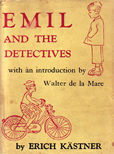
September 2012: Erich Kästner's "Emil and the Detectives" and our October book

Today was spent tracking criminals through the back streets of Berlin with Emil (Tischbein) and his two dozen or more young friends, as we reviewed Erich Kästner's 1928/9 classic children's book, Emil and the Detectives.
Born in 1899 in Dresden, by 1927 Kästner had established himself in Berlin as a prolific and respected journalist and author, and one of the most important intellectual figures in pre-WW2 Germany. A pacifist who had served as a young soldier at the end of WW1, he published poems and articles in many important periodicals and newspapers. During the book burnings in Berlin's Opernplatz on 10 May 1933 he was personally denounced (amongst others) by Goebbels in what is now known as 'die Feuerrede' (the fire speech), and his works were thrown onto the bonfires - with the exception of Emil and the Detectives, which presumably stood alone in matching up to the regime's demand for "decency and morality in family and state".

"Gegen Dekadenz und moralischen Verfall! Für Zucht und Sitte in Familie und Staat! Ich übergebe dem Feuer die Schriften von Heinrich Mann, Ernst Glaeser und Erich Kästner."  (Against decadence and moral decay! For decency and morality in family and state! I hand over to the fire the writings of Heinrich Mann, Ernst Glaeser and Erich Kästner.)
Our knowledge of the ghastly events that were just around the corner for Emil, his friends and their families adds a real poignancy to this simple yet enormously satisfying story. 1920s Berlin comes happily to life as Kästner locates the action firmly in its bohemian café society. Music plays in the streets, there's the smell of frying sausages in the air and the villain enjoys his coffee and a cigarette at a table in the famous Café Josty (the pre-war meeting place for Berlin's writers and artists which was destroyed during WW2 and has been reincarnated in the Sony Centre, one of Berlin's modern landmarks). 
The boys of 1920s Berlin had enviable freedom: unhampered by over-anxious parents with mobile phones they roamed the streets having wonderful adventures, while still managing to be incredibly polite to grown-ups and thoughtful of each other. They are largely unconcerned by social differences: Emil is a country mouse in town, but is welcomed by the streetwise young Berliners. The children - more than a hundred of them by the end of the book - inhabit their own exciting world and operate just under the adult radar; free to come and go, they have adventures that turn out well for all concerned, while a slice of apple cake and a hot chocolate is fair reward for their efforts.
Wittily illustrated by Walter Trier (an anti-fascist who was also bitterly opposed to - and by - the Nazi regime), and with Kästner's occasional humorous asides and sly insertion of himself into the story, adult readers are kept as amused as their younger audiences, and the book is refreshingly free of moralising (apart from Grandma's outdated exhortion to "always send cash through the post"). There's even the mandatory comic policeman who can't remember Emil's surname.  However, Walter de la Mare's lengthy introduction was universally condemned as a dreadful plot spoiler!
There was some discussion of the quality and nature of the English translation from the original German (we were reading Eileen Hall's 1959 version), with the view expressed by those of the group who are German speakers that the book is more genteel in tone than would have been the case. Perhaps there's an opportunity for a new translation of Emil that uses a more authentic voice and replicates the Berlin street slang of the original? The portrayal of Pony, the only girl in the story, although understandable for its time, was something of a disappointment. Despite her seeming liberation at first, with her bicycle and her brisk approach to boys, she remained firmly in the role of home-maker and head chef.
All that said, we loved our brief stay in pre-war Berlin. In comparison to the more sophisticated stories that children read today, Emil and the Detectives is a charming, simple yet fast-paced story that ends well and leaves the reader satisfied that all's right with the world.

At our next meeting we will be reviewing Joan Aiken's historical novel for young adults, Midnight is a Place (1974).

Wednesday, 11 January 2012

January 2012: Enid Blyton's "First Term at Malory Towers" and our next book

Jolly hockey sticks (or rather, lacrosse sticks)!  We returned to 1940s England for some middle-class girls' boarding school fiction this month when we read First Term at Malory Towers by Enid Blyton. 
Well, our sour faces said it all!  What a change from the joyful cheers that had been raised last month when we agreed on this favourite book!  (Please note the elaborate use of exclamation marks here, in tribute to the favourite chapter-ending style of the author.)  What a shock to read about Darrell Rivers and her classmates with 30+ years' hindsight and through 21st century eyes.  The endemic bullying, the violence (euphemistically described as 'scolding'), the stereotypes, the priggishness, the underlying theme of relatively low expectations for 'first-rate girls', the lack of character development, the celebration of mothers if they were 'sensible' and 'pretty', the general feeling of being drowned in saccharine ... it seemed that no-one really enjoyed the school on the Cornish cliffs this time around (apart from the description of the wonderful swimming pool by the sea).  In fact, several of us who had loved Malory Towers as children - despite the secret-code language of 'hols' and 'dormies' and 'beastly' girls - had discovered that we were very reluctant to read it again, all too aware that our precious memories would be unpleasantly shattered.  And so they were.

Blyton herself said: '[M]y public, bless them, feel in my books a sense of security, an anchor, a sure knowledge that right is right, and that such things as courage and kindness deserve to be emulated. Naturally the morals or ethics are intrinsic to the story—and therein lies their true power.' Her recurring theme was that good children are rewarded with friends and honours, while naughty children are given a precious chance to repent and become worthy. Problem children are reformed, simply by being part of the school and absorbing its special atmosphere. From our modern perspective however, the judgements are harsh and the treatment of unfortunate or noncomformist children is downright cruel, while gender and social stereotyping makes the reading even more uncomfortable.

Much has been written in the academic literature about Enid Blyton which will not be repeated here, but one of our group was lucky to have had Sheila Ray as a tutor: her 1982 book The Blyton Phenomenon examines the controversy surrounding her work and the reasons for her effective exclusion from the BBC and from public libraries over the years, meaning that her books were often bought as treats or given as gifts.  We discussed the negative authority-figure responses to a diet of Blyton, and so we were particularly delighted when another of us brought along a very competent short story she had written aged about eleven called First Term at Riverton Manor: clearly entirely based on Malory Towers

We also discussed the re-packaging and modern re-editing of the original stories, as well as the spin-offs by Pamela Cox, and we mentioned in passing modern books on the school theme such as Beswitched by Kate Saunders and J K Rowling's Harry Potter series.

Well, we've had enough of middle-class children for the moment, so we're going to tackle David Almond's My Name is Mina this month, the book he published in 2011 as the prequel to his 1998 success, Skellig (which won both the Whitbread Children's Award and the Carnegie Medal).

Thursday, 8 December 2011

December 2011: Susan Coolidge's "What Katy Did" and our next book

We decided it was time to cross the Atlantic and dip into some late 19th century domestic fiction for girls, so this month was all about Katy and What She Did.  Susan Coolidge (Sarah Woolsey, 1835-1905) established herself as an author by writing semi-biographical and charming but morally didactic stories about the six middle-class children of Dr Carr, whose motherless household is managed by stern but well-meaning Aunt Izzie.
Most of us remembered reading What Katy Did (1872) as children and we were delighted to get the chance to read it again with adult eyes.  It proved to be an interesting experience second time around - almost too much for some who were overwhelmed by the sugary story with its moralising underpinnings and had to resort to skim reading.  However, we all pushed on through the rather dull opening pages with their references to John Bunyan's The Pilgrim's Progress to rediscover a humorous book with many well-drawn and closely-observed characters and events.

We talked about the frequent appearances of heroic bed-ridden invalids in Victorian children's fiction: Coolidge's Katy and her too-good-to-be-true cousin Helen; Dick in Louisa M Alcott's Little Men (1871); Clara in Johanna Spyri's Heidi (1872); Colin in Frances Hodgson Burnett's The Secret Garden (1911); Pollyanna in Eleanor Porter's Pollyanna (1911) and Tiny Tim in Charles Dickens' A Christmas Carol (1843) being just a few examples.  Several of us recalled bed-ridden Marianne in Catherine Storr's powerful and eerie classic, Marianne Dreams (1964).  We discussed the recurring theme in which an undisciplined and headstrong character - frequently a tomboyish or non-conformist girl - suffers an injury directly as a result of their own disobedience, and learns discipline through long-term suffering and immobility.  Cousin Helen, permanently disabled, tells injured Katy that she must study in God's "School of Pain" to learn lessons in "Patience" and "Making the Best of Things" and so become the "Heart of the House".  See The Treatment of Disability in 19th and Early 20th Century Children's Literature by Ann Dowker of the Department of Experimental Psychology, University of Oxford at http://dsq-sds.org/article/view/843/1018

We reviewed too Susan Coolidge's own life and circumstances and talked about the influence of Louisa M Alcott (Little Women etc) on Coolidge's writing direction and style, and the fact that both these authors remained unmarried - resonating with Virginia Woolf's thoughts about the consequences for writers of marriage and domestic duties in her essay "A Room of One's Own" (1929).

What Katy Did and What Katy Did At School are often credited with sparking abiding interest in writing school fiction for girls.  Next month (11 January 2012) we are back on this side of the Atlantic to explore this genre with First Term at Malory Towers by Enid Blyton (1946).  It's a quick read, so a suggestion for a companion book is Beswitched by Kate Saunders (2010) which combines the story of Flora Fox at a girl's boarding school with magic spells and time travel.