Showing posts with label Susan Coolidge. Show all posts

Thursday, 8 December 2011

December 2011: Susan Coolidge's "What Katy Did" and our next book

We decided it was time to cross the Atlantic and dip into some late 19th century domestic fiction for girls, so this month was all about Katy and What She Did.  Susan Coolidge (Sarah Woolsey, 1835-1905) established herself as an author by writing semi-biographical and charming but morally didactic stories about the six middle-class children of Dr Carr, whose motherless household is managed by stern but well-meaning Aunt Izzie.
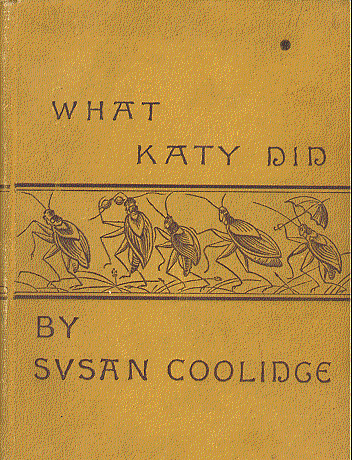
Most of us remembered reading What Katy Did (1872) as children and we were delighted to get the chance to read it again with adult eyes.  It proved to be an interesting experience second time around - almost too much for some who were overwhelmed by the sugary story with its moralising underpinnings and had to resort to skim reading.  However, we all pushed on through the rather dull opening pages with their references to John Bunyan's The Pilgrim's Progress to rediscover a humorous book with many well-drawn and closely-observed characters and events.

We talked about the frequent appearances of heroic bed-ridden invalids in Victorian children's fiction: Coolidge's Katy and her too-good-to-be-true cousin Helen; Dick in Louisa M Alcott's Little Men (1871); Clara in Johanna Spyri's Heidi (1872); Colin in Frances Hodgson Burnett's The Secret Garden (1911); Pollyanna in Eleanor Porter's Pollyanna (1911) and Tiny Tim in Charles Dickens' A Christmas Carol (1843) being just a few examples.  Several of us recalled bed-ridden Marianne in Catherine Storr's powerful and eerie classic, Marianne Dreams (1964).  We discussed the recurring theme in which an undisciplined and headstrong character - frequently a tomboyish or non-conformist girl - suffers an injury directly as a result of their own disobedience, and learns discipline through long-term suffering and immobility.  Cousin Helen, permanently disabled, tells injured Katy that she must study in God's "School of Pain" to learn lessons in "Patience" and "Making the Best of Things" and so become the "Heart of the House".  See The Treatment of Disability in 19th and Early 20th Century Children's Literature by Ann Dowker of the Department of Experimental Psychology, University of Oxford at http://dsq-sds.org/article/view/843/1018

We reviewed too Susan Coolidge's own life and circumstances and talked about the influence of Louisa M Alcott (Little Women etc) on Coolidge's writing direction and style, and the fact that both these authors remained unmarried - resonating with Virginia Woolf's thoughts about the consequences for writers of marriage and domestic duties in her essay "A Room of One's Own" (1929).

What Katy Did and What Katy Did At School are often credited with sparking abiding interest in writing school fiction for girls.  Next month (11 January 2012) we are back on this side of the Atlantic to explore this genre with First Term at Malory Towers by Enid Blyton (1946).  It's a quick read, so a suggestion for a companion book is Beswitched by Kate Saunders (2010) which combines the story of Flora Fox at a girl's boarding school with magic spells and time travel.

Thursday, 3 November 2011

November 2011: Robert Louis Stephenson's "Treasure Island" and our next book

Avast be'ind, mateys!  October was all about pirates.  We sailed on the Hispaniola from Bristol to the Caribbean with Jim Hawkins, hid in an apple barrel, defeated a mutiny, disposed of Israel Hands, discovered Captain Flint's treasure - and got safely back from the eighteenth century to Bath Library in time to discuss Robert Louis Stephenson's Treasure Island at our November meeting.  And no, we didn't talk like pirates ... much!

First serialised in 1881-2 and then published as a book in 1883, Treasure Island established the gold standard for pirate stories ever since, so there was much for us to talk about: the - often impenetrable - technical details of knots and rigging; the characterisations of the heroes and villains; the nature of leadership; the serial style of the book with its cliffhangers and short chapters; Long John Silver's longevity as a fictional icon; and the moral ambiguity and complexity of this most manipulative and yet most enduring of characters.

But does Treasure Island still appeal?  The answer seems to be a resounding "yes" - with some reservations.  Despite the occasional nautical language, it was variously described as gripping and easy to read, with atmospheric opening chapters and some truly terrifying characters - particularly Pew (who we learned is never actually called "Blind Pew" in the book).  However, there is an imbalance between Stephenson's multi-dimensional, often complex characterisations of the "baddies/pirates" versus his more one-dimensional and ultimately less interesting "goodies/gentlemen".  It is possible to believe in and be both terrified by and attracted to Silver ... as Jim was.  He has the qualities of a leader and the flaws of a man.  Squire Trelawney on the other hand has little depth as a character and less for the reader to care about or relate to in consequence.
Believed to be the first story book to deliberately target both adults and children, creating the "cross-over" genre exploited most recently by J K Rowling's Harry Potter series, Treasure Island is still borrowed from libraries by all age groups.  It has been reproduced in a wide range of formats, from film to audio, from cartoon books to Ladybird children's versions, and as a result the story is extremely accessible to a wide range of readers, listeners and watchers. 

As a group, our "memorable moments" were wide-ranging, demonstrating the book's breadth, depth and appeal.  From the skeleton arranged to point towards Flint's treasure, to Ben Gunn ("many's the long night I've dreamed of cheese - toasted, mostly"), to Jim's mortal combat with Israel Hands on the deserted Hispaniola, to Pew blindly tapping his way towards Billy Bones at the Admiral Benbow ... and many more.

Treasure Island has established an enduring legacy.  From established and familiar catch phrases like "Them that die'll be the lucky ones", or "Toasted mostly", or "Yo ho ho and a bottle of rum" through to how we think about pirates and parrots and treasure maps where X marks the spot ... and NEVER forget the Black Spot!

Next month's book is What Katy Did by Susan Coolidge.  What a contrast that will be!