Showing posts with label Diana Wynne-Jones. Show all posts

Sunday, 28 September 2014

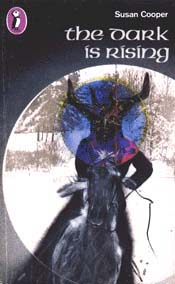
The Dark is Rising by Susan Cooper (1973)

The Dark is Rising is the second and best known book in Susan Cooper's Dark is Rising sequence which draws on Arthurian Legend and British folklore.

Cooper studied English at the University of Oxford, one of a group of authors (including Alan Garner, Diana Wynne Jones and Penelope Lively) who were to make a powerful impact on children's literature in the 1960s and 1970s.

This book led to one of the most enthusiatic discussions our group has had, with die-hard Cooper fans and first-time readers all enjoying the story and Cooper's powerful, engaging writing. As with Alan Garner's writing, Cooper conjured up moments of genuine terror in her story and wove a dark, magical tale which is grounded in the English landscape as well as its folklore.

Susan Cooper is still  writing today, with her recent book Ghost Hawk being nominated for the Carnegie Award.


Tuesday, 26 February 2013

February 2013: Diana Wynne Jones' "Magicians of Caprona" and our March bookbook

The Montagues and the Capulets; the Sharks and the Jets?  This month we came face to face with Diana Wynne Jones' magical Montanas and Petrocchis in The Magicians of Caprona (1980), the third book in her Chrestomanci series.
The two warring Italian families live in their sprawling, fortified spell-houses in the city state of Caprona, located somewhere between Florence, Siena and Pisa and set in an indefinable time - a "world parallel to ours, where magic is as normal as mathematics and things are generally more old-fashioned".  Caprona is rather like Lyra's Oxford in Philip Pullman's His Dark Materials trilogy (1995-2000).  The tourist buses circulate, while the families ride in magical horse-drawn carriages and work at spells in the Scriptorium.  Sworn enemies, they do everything they can to outdo one another while firmly believing the worst of each other.  But while they are fighting, they fail to notice that their city is falling under an evil enchantment.  Young Tonino is the only person in the Montana household who wasn't born with an instinct for creating spells.  His ability to communicate with cats might help Caprona - but only if he can cooperate with a girl from the hated Petrocchi family.

The book has a rather lengthy beginning, which required some application and stubborn persistence, with its numerous Italianate characters ("The Montanas were a large family") all delaying the narrative and crying out for a family tree to be included by a helpful publisher.  But right from the bright and colourful beginning, with gorgeous descriptions reminiscent of the market place in Angela Carter's short story The Kiss (1985), Wynne Jones' unique style, her powers of description and her humour shine from the pages.

"The Old Bridge in Caprona is lined with little stone booths, where long coloured envelopes, scrips and scrolls hang like bunting.  You can get spells there from every spell-house in Italy.  If you find a long, cherry-coloured scrip stamped with a black leopard, then it came from Casa Petrocci.  If you find a leaf-green envelope bearing a winged horse, then the House of Montana made it."

The story gradually darkens with family feuds, terrifying magical street battles, and a Punch and Judy sequence that plunges the protagonists into a darkly frightening place from which they must escape.  Benvenuto, the wise and independent old cat, provides Tonino with a welcome familiar in the tradition of Carbonel (Barbara Sleigh, 1955), Orlando (Kathleen Hale, 1938) and - rather more sinister - Blackmalkin (John Masefield, The Midnight Folk, 1927).  There are overtones of J R R Tolkien too - one of Wynne Jones' tutors at Oxford University where she was a student of English Literature.

The story is told from Tonino's single narrative viewpoint.  This is a useful technique, which allows a 'reveal' when a weak character (viewed from the narrator's perspective) is suddenly seen in a different light.  "Re-reading pays dividends" someone said, and for those who did re-read the book, this offered an the opportunity to appreciate the hidden dimensions of all the characters and to see the story's many different levels more clearly.

With her own memories of a difficult childhood, growing up largely without books, Wynne Jones emphasises the importance of strong family relationships and this is a story that will help children to understand that the process of growing up and breaking out can make them stronger in the end.

Alongside Magicians of Caprona, we read the transcript of a talk about Diana's work given by her son, the academic Dr Colin Burrow of All Souls', Oxford.  It was broadcast on BBC Radio Three on 4 July 2011 as part of a series The Essay: Dark Arcadias.

Further recommended reading: Four British Fantasists: Place & Culture in the Children's Fantasies of Penelope Lively, Alan Garner, Diana Wynne Jones and Susan Cooper, Charles Butler, Scarecrow Press, 2006.

For our next meeting we will be reading Mary Treadgold's Carnegie-winning book We Couldn't Leave Dinah (1941), a book that extends the conventional "pony genre" to incorporate a darker perspective of life during World War 2 - this time on an island under occupation, rather than in the cheerfully distant New York of the Melendy family.
Sunday, 13 January 2013

January 2013: Elizabeth Enright's "The Saturdays" and our February book

Remember when the weekends seemed endless, when children had time for adventures and when they were allowed to take a few risks?  Elizabeth Enright's The Saturdays (1941) captures those seemingly lost-forever golden days just perfectly.  This is the first in her series of four books about the Melendy children, who live with their widowed father in a shabby brownstone on the Lower East Side of New York City, in the days when ordinary families could occupy an entire house in Manhattan and when individual children could roam the streets of the Big Apple, relying on nice policemen to take them home on horseback if they got lost.

Loved by generations of American children, the multiple-prize-winning Enright and her charming stories are surprisingly and undeservedly less well known on this side of the Atlantic than they should be.  Her format is familiar but always popular: the somewhat chaotic and slightly impoverished but affectionate household, with a single (often professionally absent) parent; a beloved housekeeper who valiantly tries to keep everyone in check; a scruffy mongrel dog; a group of children who each have their own talents - in this case the musical one, the dramatic one, the scatty one and the Youngest One - while Time hangs heavy and there are opportunities for good-natured mischief, scrapes and adventure.

The four Melendy children pool their weekly pocket money so that each child in turn can afford a Big Adventure.  And these are very nice children, whose adventures all become learning experiences, most of which would make any parent proud: a trip to an art gallery, an outing to the opera, a visit to the hairdresser's, an afternoon at the circus and boating on the lake in Central Park.  There's no wasting of talent here.  

But there's a darker undercurrent too.  The children hear about the seamier side of life from people they encounter along the way: one was kidnapped by gypsies, while another was driven out of her abusive home with her brother and lived on the city's streets.  The Melendys nearly die from carbon monoxide poisoning one night, and on another occasion they accidentally set fire to their own home.

The joy of reading Enright is in the neatness of her structure and the simple purity and clarity of her writing.  Her children are wonderfully characterised, while humour prevents them from descending into cuteness. She also imparts a genuine sense of time and location, weaving real people, places and events through the narrative, which makes the stories both believable and effective. She writes about New York City in 1941 with the affectionate eye of a local, but a strong awareness of the plight of children thousands of miles away in London suffering from nightly bombing raids.  

Elizabeth Enright was born in 1909 to a political cartoonist father and a mother who was a designer and illustrator.  Her maternal uncle was the famous architect Frank Lloyd Wright.  Enright followed in her (by then divorced) parents' footsteps, going to  art college and herself becoming an illustrator before turning to writing and then to literary criticism.  She won the Newbery Prize for children's writing in 1939 (the equivalent of the UK's Carnegie Medal), the first of many such awards.  She was also a successful writer of short stories for adults.  There is some confusion surrounding her early death in 1968 aged just 58: some internet sources claim she committed suicide, while her New York Times obituary simply states that she died at home following a short illness.  

What a wonderful discovery this book was for us all.

Next month we are reading The Magicians of Caprona by Diana Wynne-Jones (1980), together with a posthumous reminiscence about Diana by her son, Colin Burrow, which was broadcast on Radio 4 in 2011.